
Learning Maturity Questionnaire

A business sits in one of 5 stages of learning maturity.
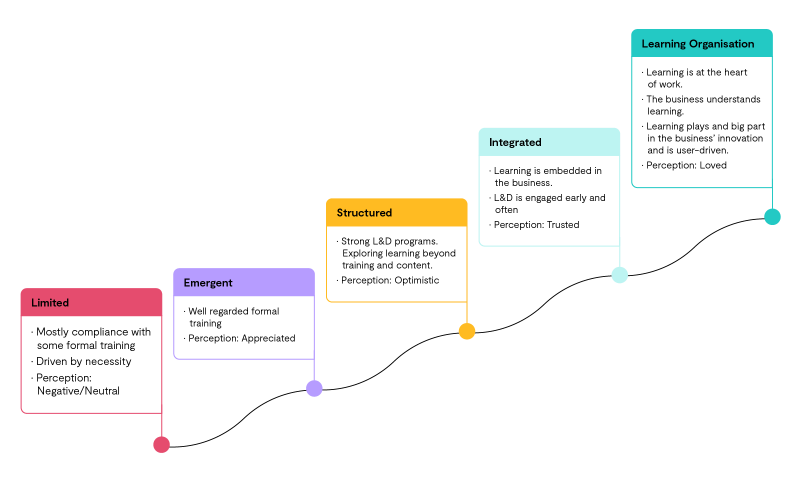
From Limited ad-hoc, haphazard training driven by compliance and workplace issues… through to a performance focused, human-centred, innovative Learning Organisation.

Answer each of the questions on a 1 to 5 scale

  1. Never
  2. Rarely
  3. Sometimes
  4. Usually
  5. Always

At the end of the questionnaire you'll find out where in the model you sit, and more importantly what that means and what you can do about it!

Thank you!

Based on your answers your team or organisation is currently sitting at [TBC] stage in regard to learning maturity.

To request the report that will provide more detail on what that part of the model means and the levers within your control to progress to a higher level of maturity please email stu@inspiregroup.com.au.

  1. An L&D representative is brought into a project at the start
  2. Your team has a process for evaluating and selecting new technology (e.g., authoring tools, LMS)
  3. L&D can make decisions and own specific projects
  4. L&D has a process for finding and hiring vendors and contractors
  5. L&D's work can be directly linked to the business' strategic goals
  6. There is a defined process for identifying which deliverables or activities are optimal for learning needs
  7. L&D shares knowledge within the business
  8. L&D shares knowledge with the wider learning industry
  9. The way your team works is continuously improved upon based on lessons learned
  10. L&D's work has a consistent level of quality
  11. Everyone in the L&D team can describe the main business areas of the organisation and what they do
  12. Most of the business regards L&D's work as high quality
  13. Deadlines are consistently met
  14. Projects are delivered within the original budget
  15. Every piece of work starts with some form of research and/or analysis
  16. Completion of learning activities and content is measured
  17. Your team has control over the configuration and maintenance of all L&D related technology

You're over halfway and you're doing great!

  1. Your team has goals that align with the business' strategic goals
  2. You have specialised learning practitioners within the business
  3. Leaders believe in the value of learning and role model that belief
  4. Everyone in the L&D team can describe the products and/or services offered by the organisation
  5. Mistakes are viewed as a feature of the learning process in the organisation
  6. Achievement of learning outcomes are recognised and celebrated including positive case studies
  7. Career development is planned and visible across the business
  8. Learning opportunities are integrated into the work that people do
  9. Learning outputs are consistently iterated upon and updated post launch
  10. A consistent design methodology is used across the business for all projects
  11. There is a clear understanding of what learning is and means within the business
  12. L&D has strong, collaborative relationships with other people-focused business areas, e.g. HR, P&C, OD, Recruitment, EX, DEI, Wellbeing
  13. Everyone in the L&D team can describe the target market(s) for each product and/or service
  14. On the job performance data is captured and used for analysis, project justification and evaluation
  15. Learners are no longer spectators but collaborative partners in the creation and distribution of learning